Energy Boost
AI Campaign
Marketing Design / AI creative / Motion Graphics︎︎︎ Campaign: Energy Boost AI Campaign
︎︎︎ Role: Senior Visual Designer
︎︎︎ Channels: Meta (static + motion), YouTube
︎︎︎ Focus: Multi-channel creative tested and iterated in a live performance environment
Background
I led a growth initiative to test how generative AI could increase creative velocity, reduce costs, and improve scalability for paid Meta and YouTube, without compromising brand quality or performance. We deliberately ran this experiment against a high-stakes business initiative: Energy Boost. The campaign ran on YouTube as 8s, non-skippable video ads targeted at audiences aged 24–54.
To ensure learning was commercially meaningful, the project was underpinned by a rigorous testing plan. We designed a 28-day geo-based experiment to measure:
-
Sales incrementality of YouTube energy investment
-
Incrementality of creative strategy (multiple rotating creatives vs. a single hero)
-
Halo impact of YouTube energy spend on Broadband, SIMO, and Handset sales
This ensured AI experimentation was directly tied to incremental revenue and cross-product growth, not vanity metrics.
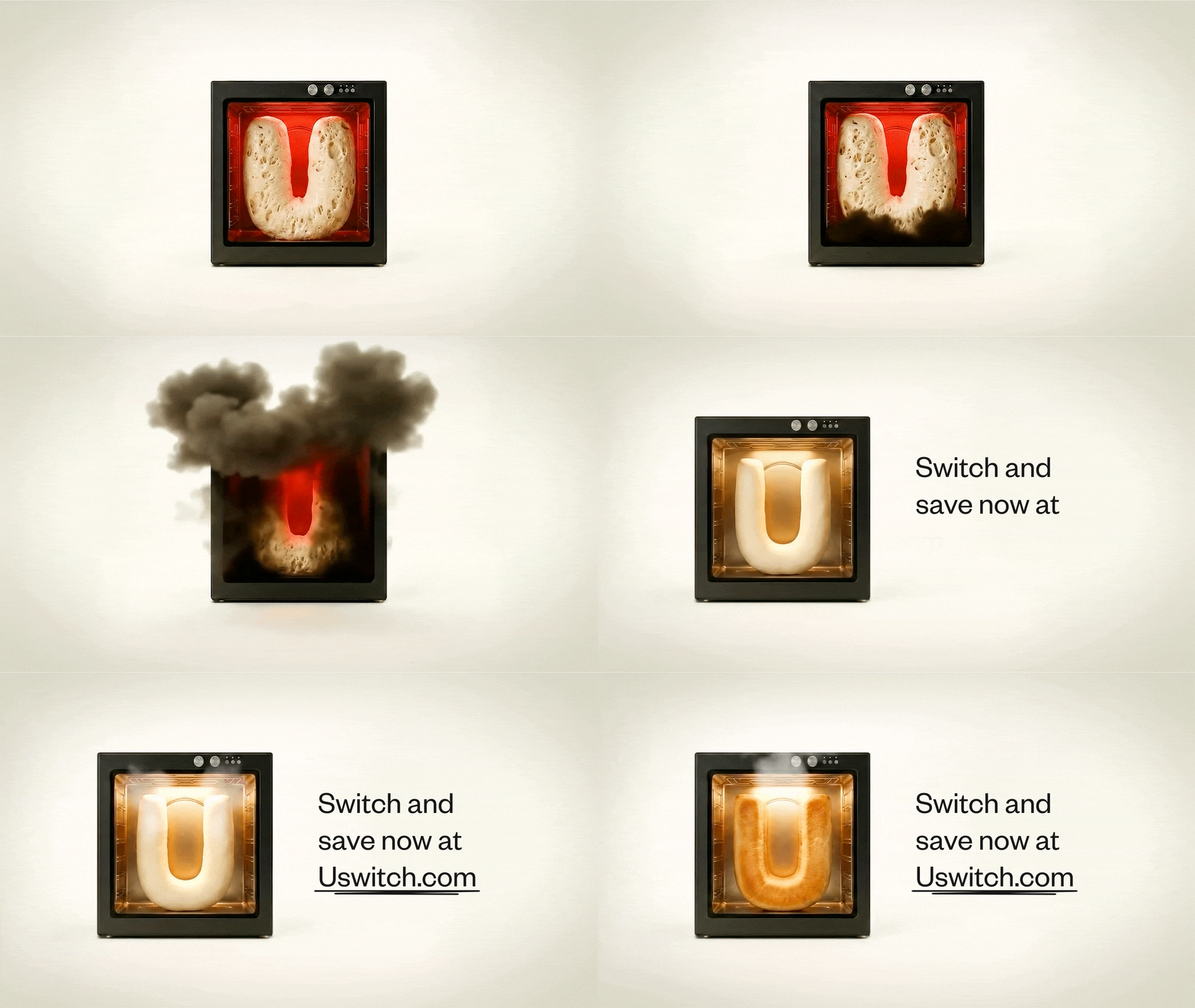
I explored how to visualise the emotional burden of high energy costs in a simple, relatable way. Household appliances were shaped into the Uswitch “U” logo, serving as a visual metaphor for everyday frustration with energy bills. For the video assets, ads followed a three-part storytelling structure, in line with Google’s ABCD (Attention, Branding, Connection, Direction) best practices:
-
Problem state – Appliances malfunctioning or glitching
-
Solution state – “Switch and save now at Uswitch.com” in the first 3 seconds
-
Branded end-frame – Clear identity + CTA
Four distinct variants were developed and tested to support high rotation and variation across Meta and YouTube, preparing the creative for early performance insights.
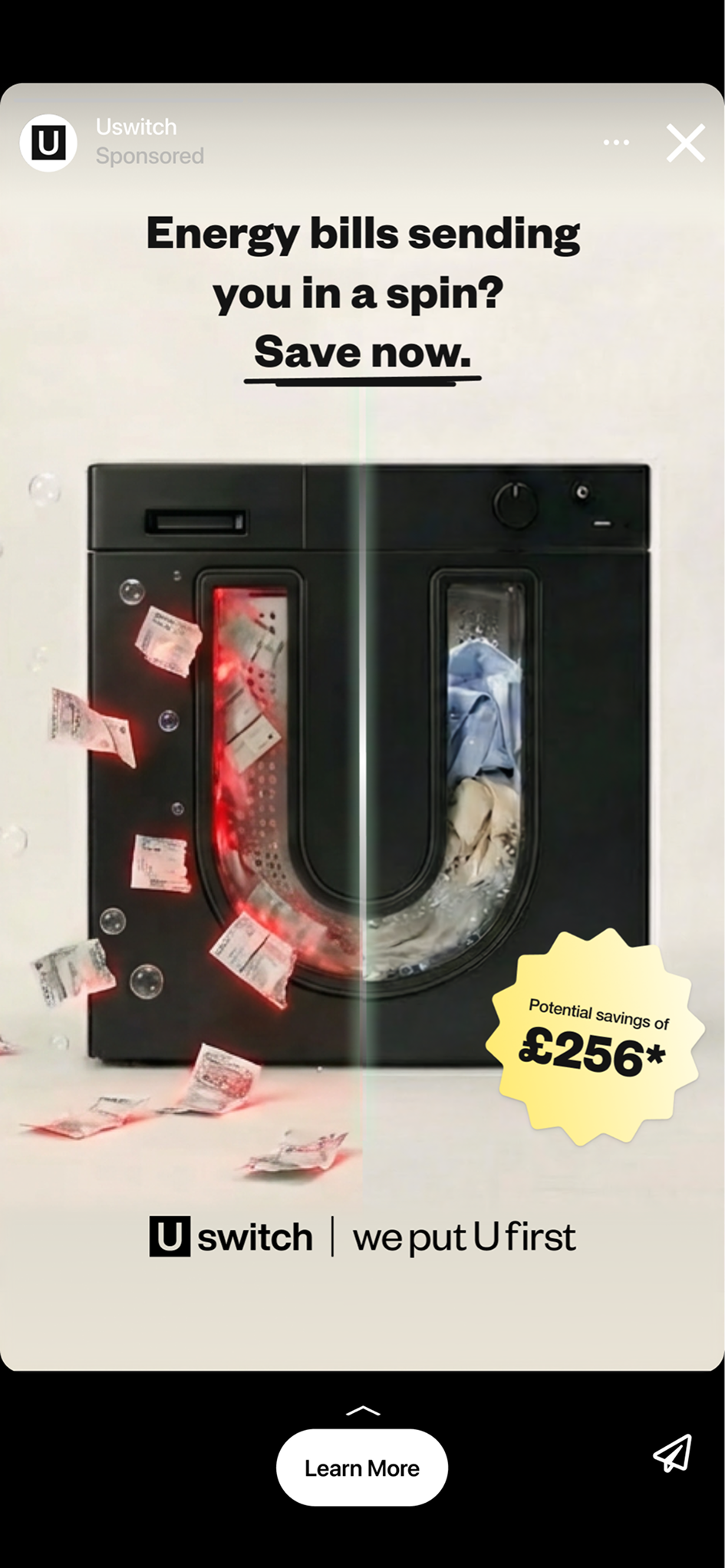
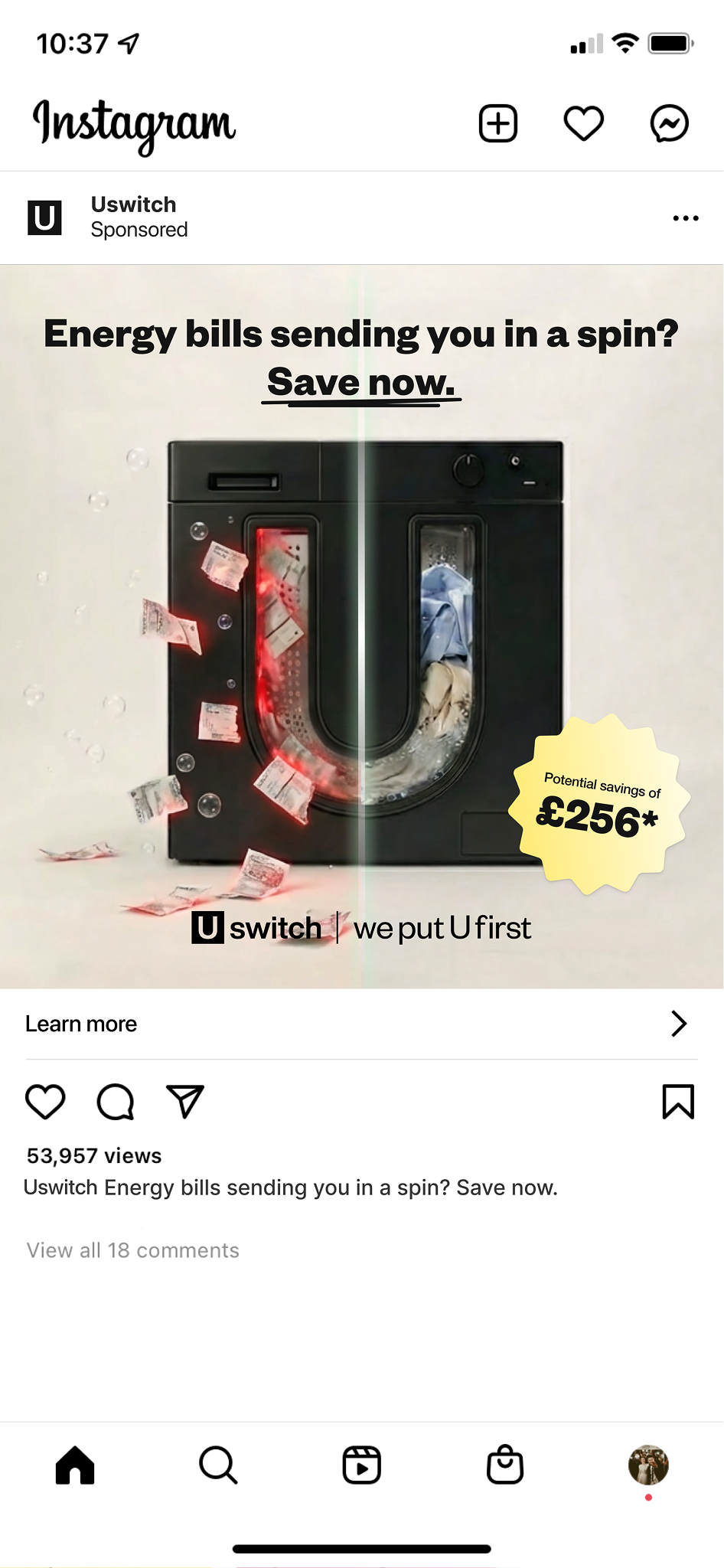
Variant 1 - Washing machine
Problem state:
A washing machine spins uncontrollably as energy bills churn inside, visually representing rising costs and loss of control over household energy spend.
Solution state:
The machine settles and reveals fresh, clean laundry, signalling relief, stability, and the return of normal household routines.
Branded end-frame:
“Uswitch We Put U First” reinforces trust and positions Uswitch as the enabler of that resolution.
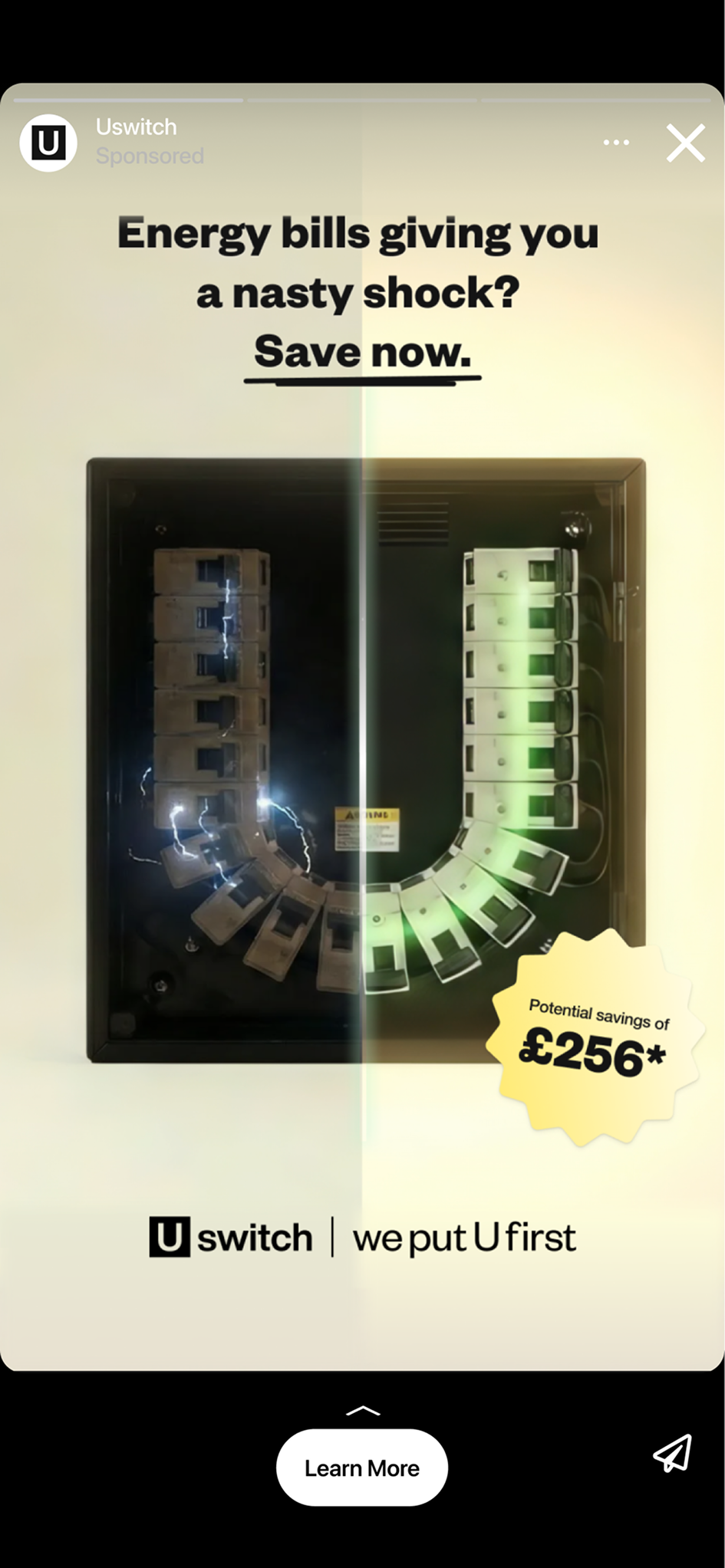
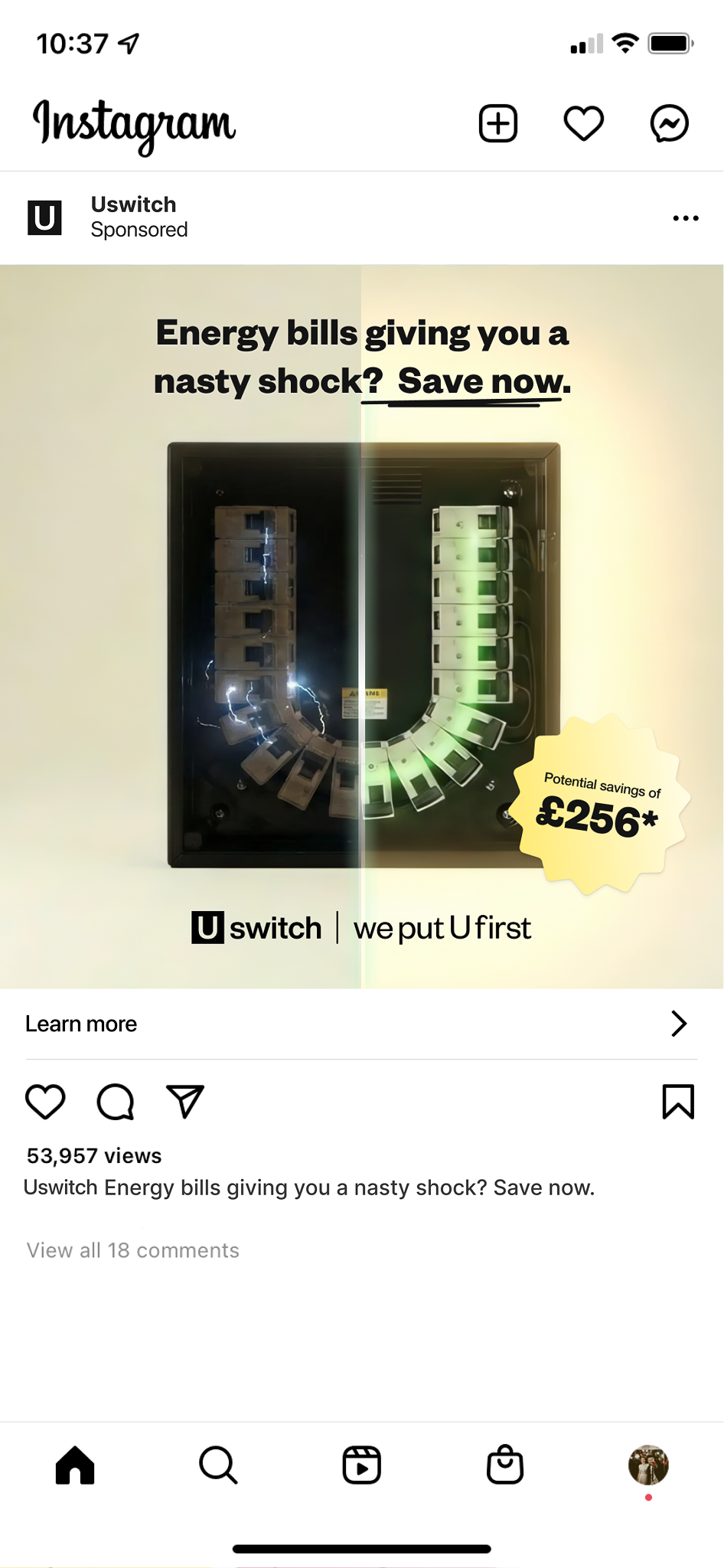
Variant 2 - Fuse box
Problem state
A fuse box crackles with visible electrical shocks, plunging the room into darkness and conveying uncertainty and disruption caused by energy costs.
Solution state
Power is restored as the fuse box returns to normal, representing reliability, security, and peace of mind.
Branded end-frame:
“Uswitch We Put U First” reinforces trust and positions Uswitch as the enabler of that resolution.
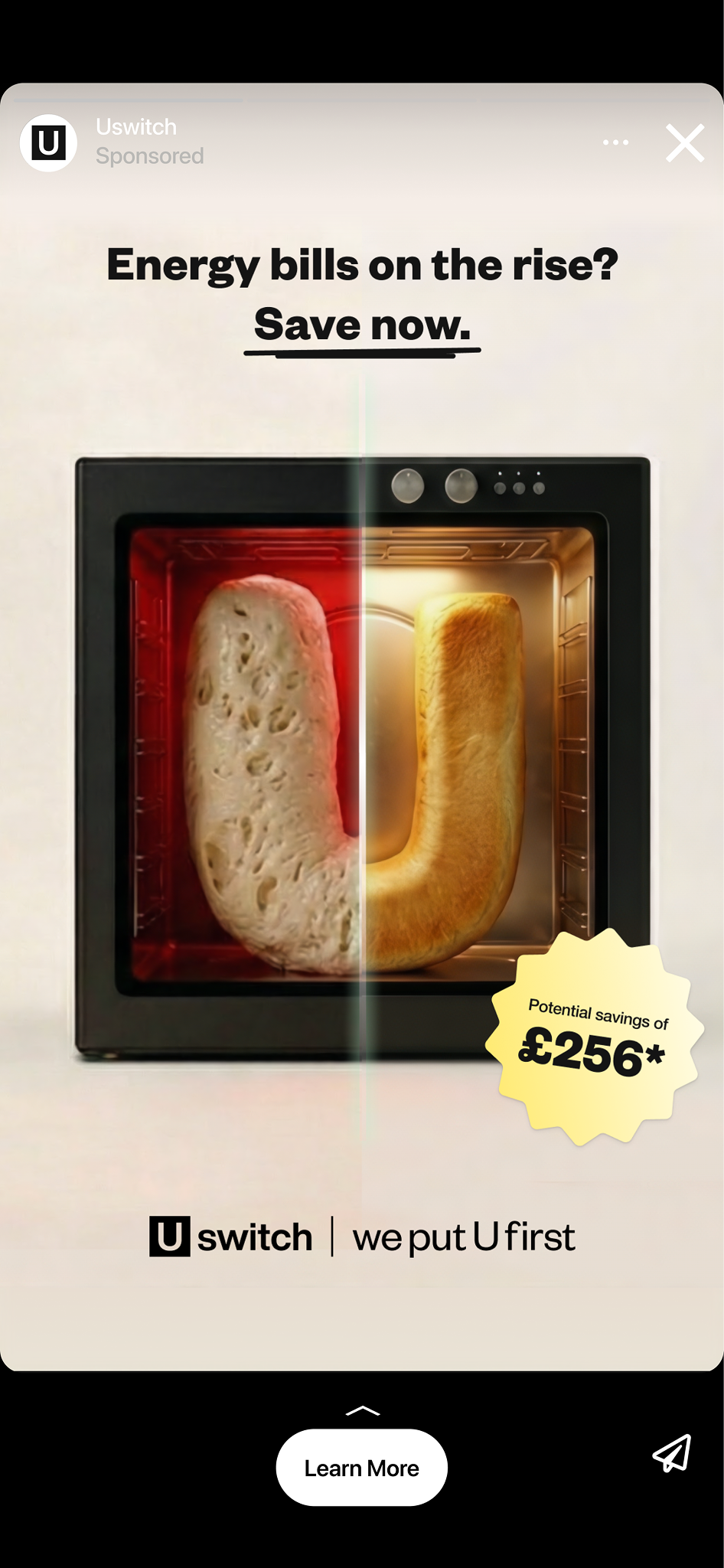
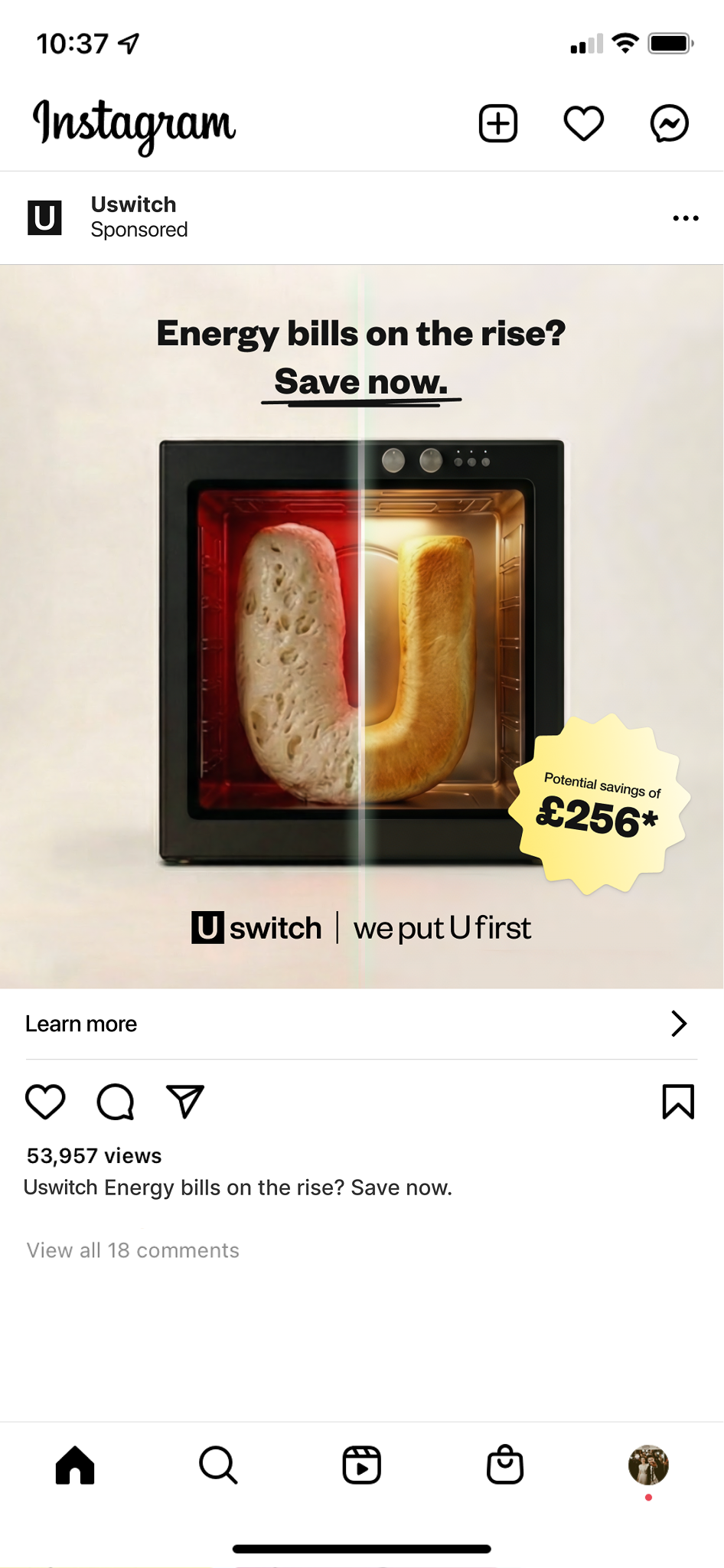
Variant 3 - Oven
Problem state
Dough rises aggressively inside an overheated oven, creating tension and unease that mirrors the pressure of increasing energy bills.
Solution state
The oven temperature stabilises and the dough bakes into a perfect loaf, symbolising control, balance, and a better outcome through smarter energy choices.
Branded end-frame:
“Uswitch We Put U First” reinforces trust and positions Uswitch as the enabler of that resolution.
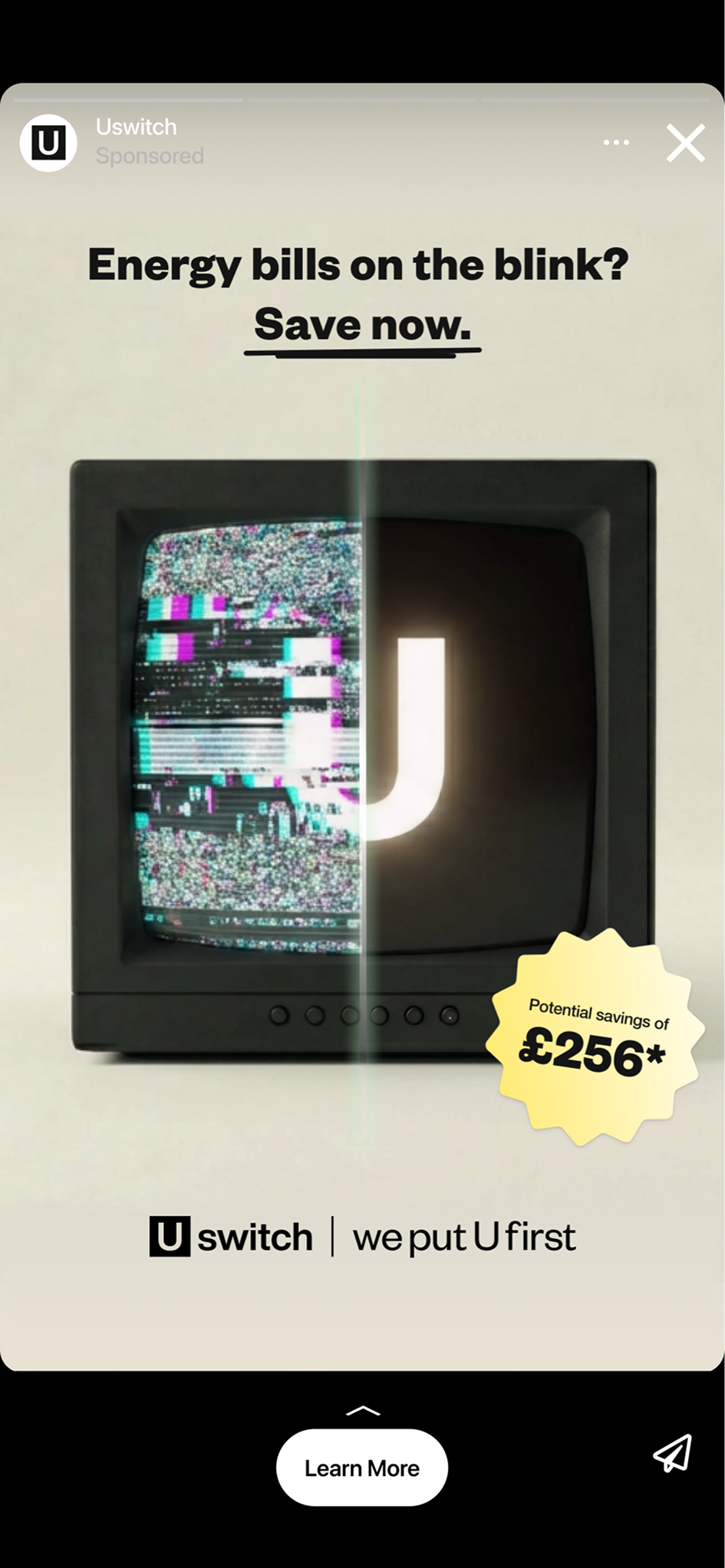
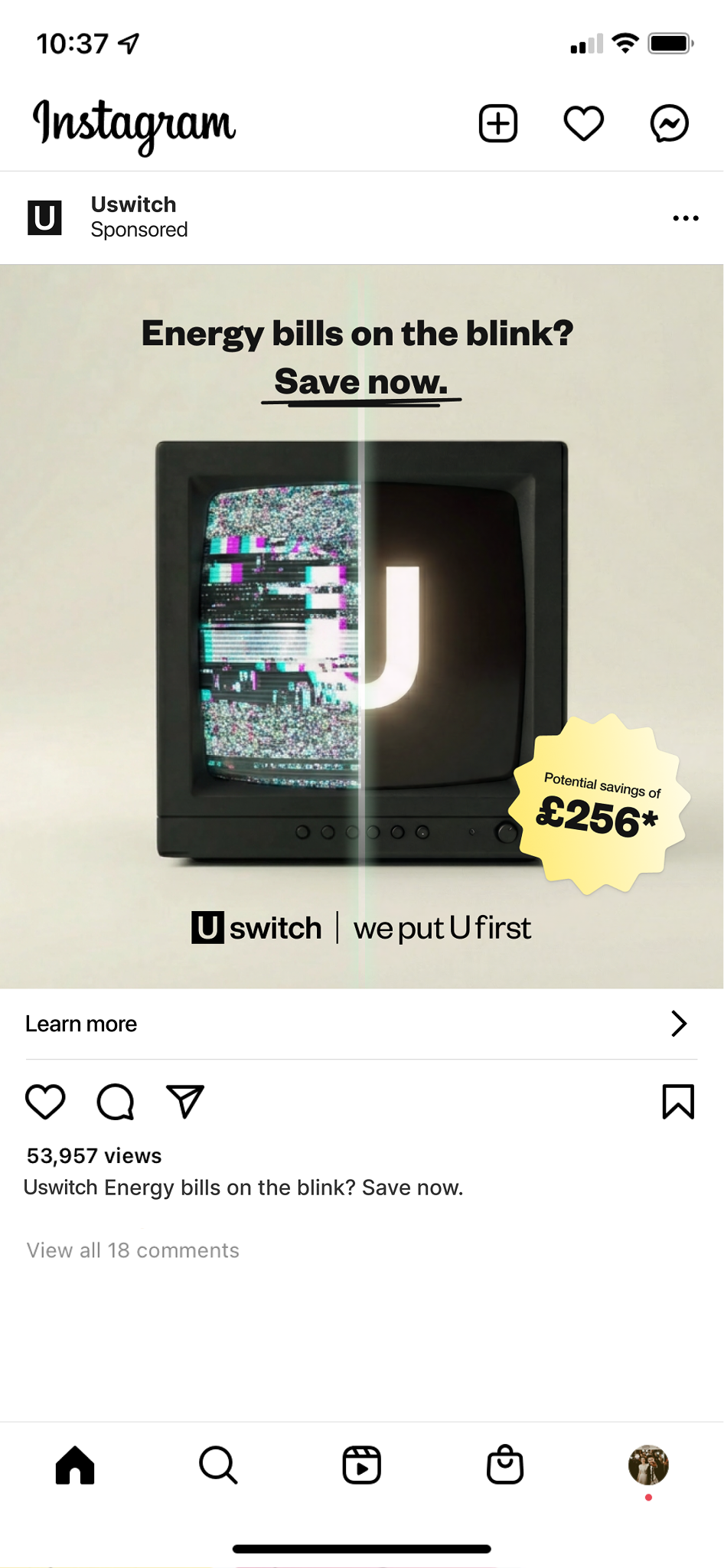
Variant 4 - TV
Problem state
The TV screen glitches with signal interference and visual distortion, creating frustration and uncertainty that reflects the disruption caused by rising energy costs.
Solution state
The signal stabilises and the screen becomes cleanly lit, revealing a calm, well-defined Uswitch “U”, symbolising restored control and clarity.
Branded end-frame:
“Uswitch We Put U First” reinforces trust and positions Uswitch as the enabler of that resolution.
Challenges
-
AI adoption risked inconsistent quality, brand drift, and unclear impact.
- I audited all marketing channels and built a Decision Framework scoring AI suitability by impact, risk, cost saving, and testability.
- YouTube paid media emerged as the highest-impact entry point, with a clear benchmark: 80% quality at 50% less effort, validated via rapid A/B testing.
- When a 20s ATL-style ad proved technically unfeasible, I pivoted to 8-10s YouTube non-skippable ads, aligning with platform best practices and delivery constraints.
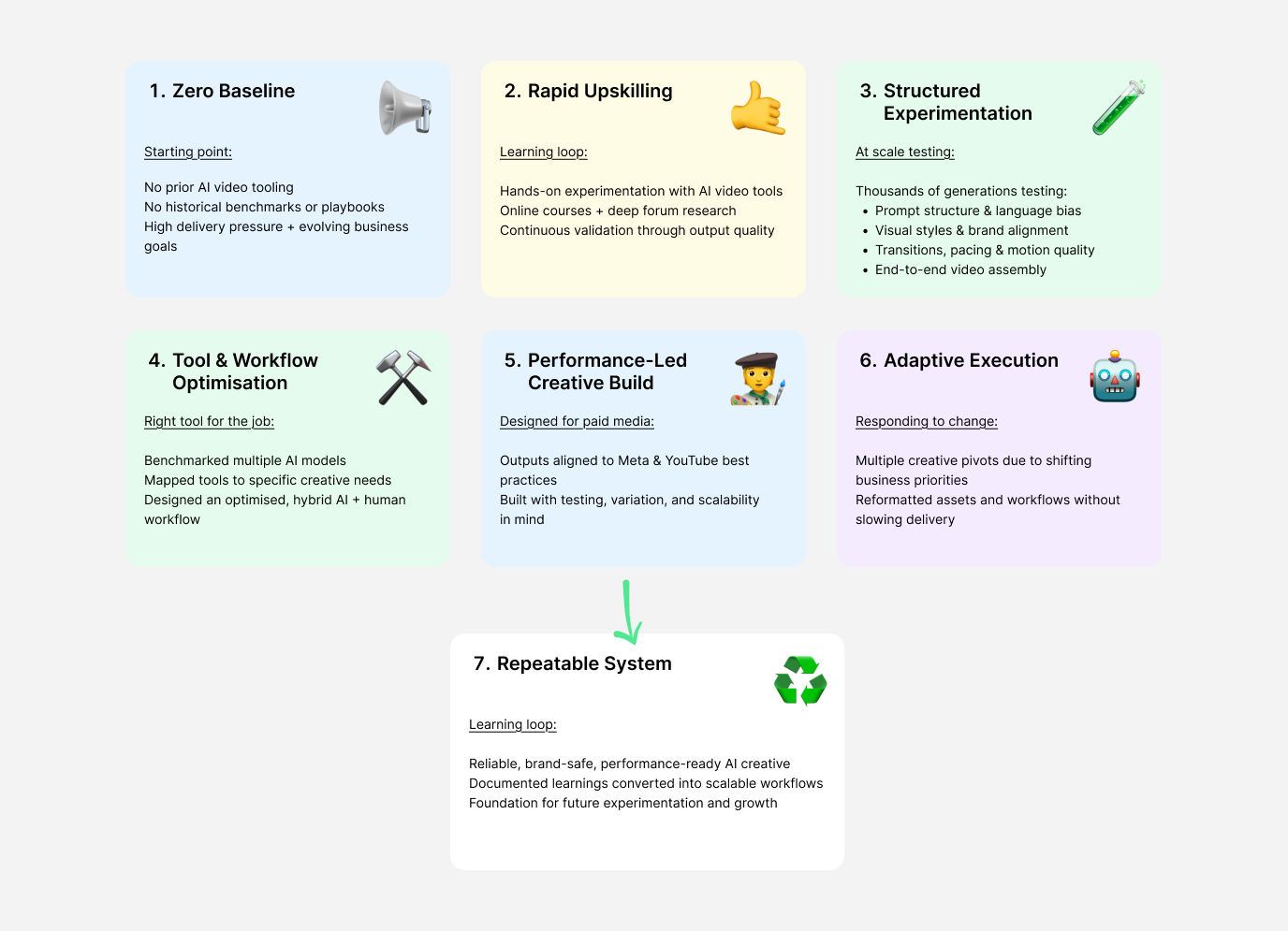
From Zero to Scalable AI Performance Creative
Results
- The AI creative campaign drove clear incremental growth, generating a 14.9% revenue uplift and a blended 3-month ROI of 1.89.
- Washing Machine variant (ran in Bristol) generated the highest 3-month ROI at 2.57. Fuse Box variant (ran in Newcastle) followed closely with a 3-month ROI of 2.43, while the Oven variant (ran in Liverpool) delivered a 3-month ROI of 2.18.
- The AI creatives tested to be highly commercially viable while significantly reduced production time and cost vs. traditional agency workflows.
- Established a repeatable AI testing framework for performance creative.
Process
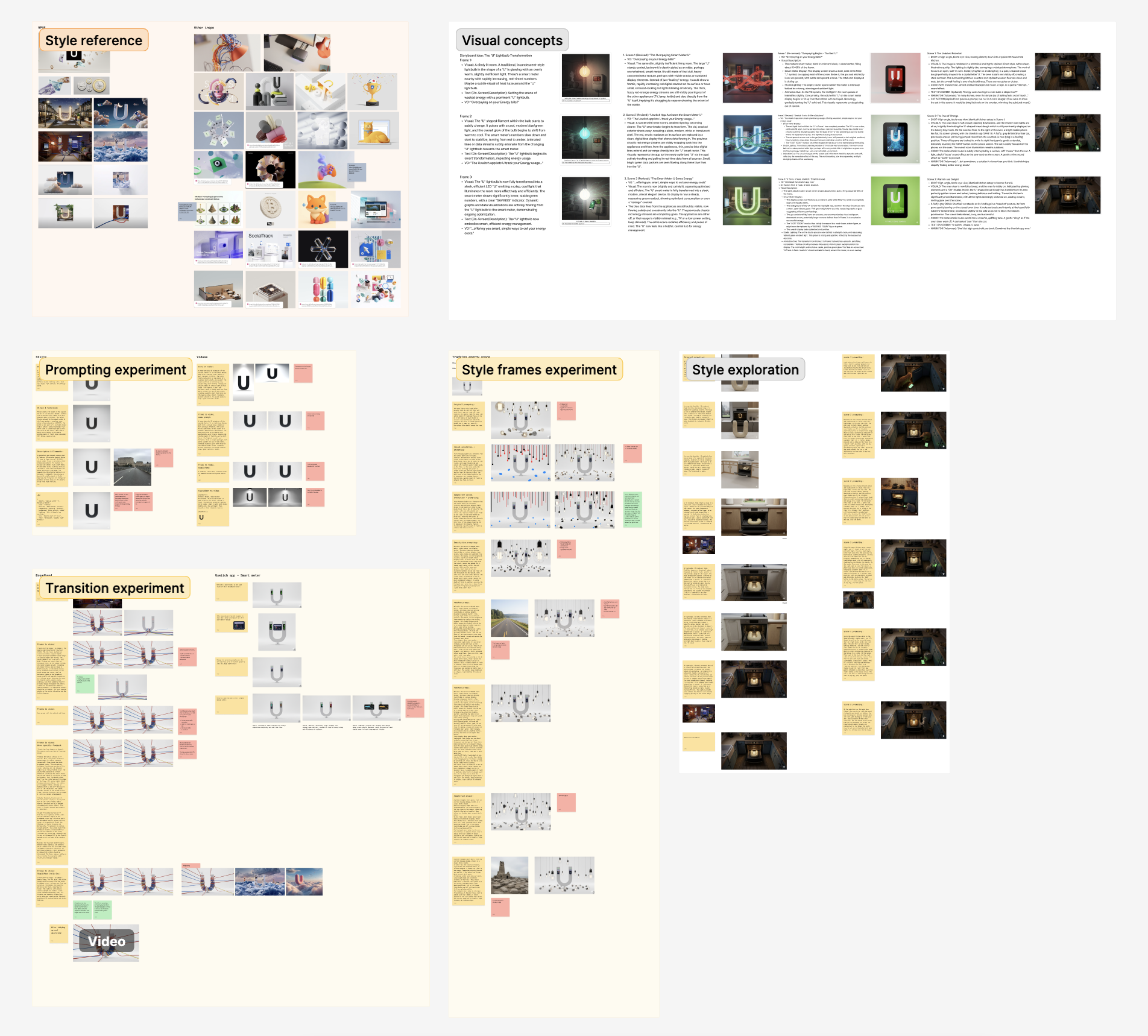
Process work in FigJam
![]()
Video development with iterations
![]() Storyboards for the 20S ATL-quality paid video before the brief change
Storyboards for the 20S ATL-quality paid video before the brief change
Video experiment for the 20S ATL-quality paid video before the brief change
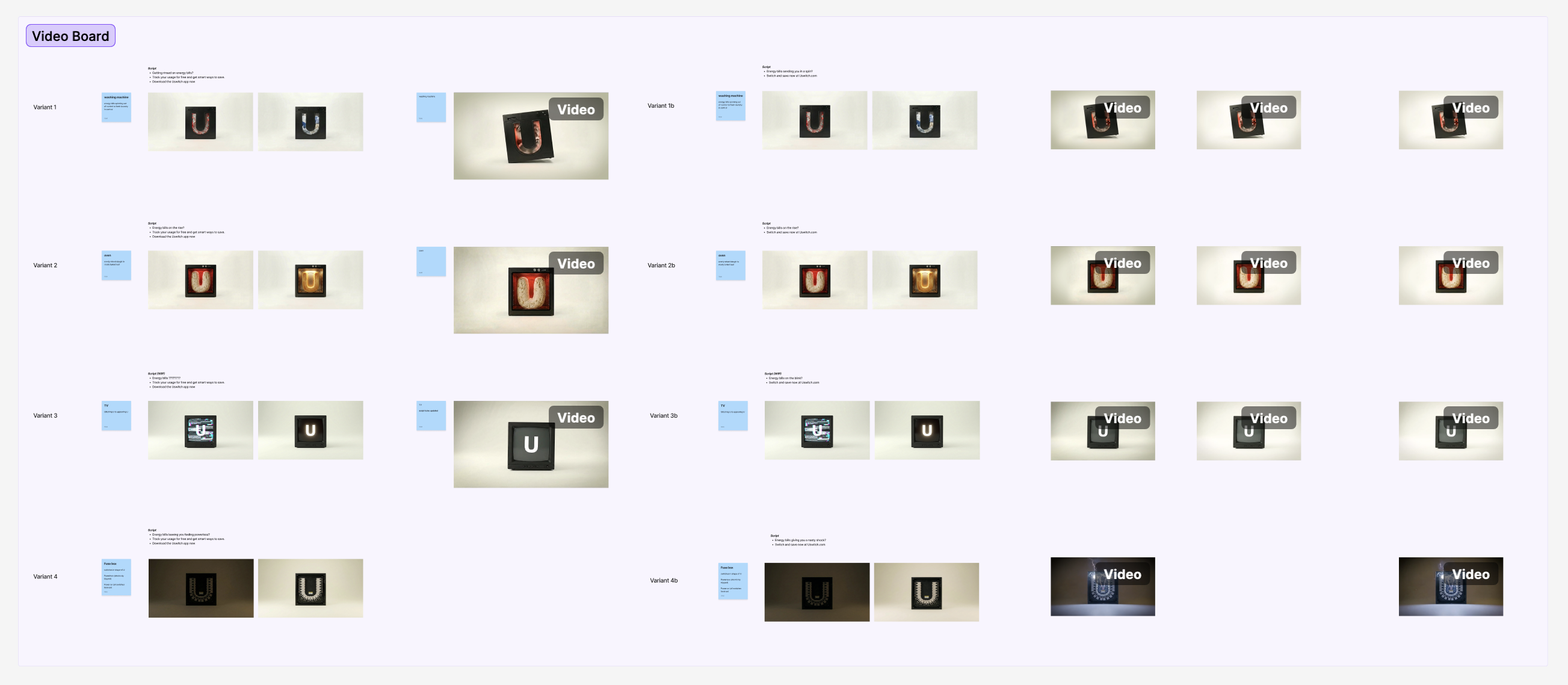
Video development with iterations
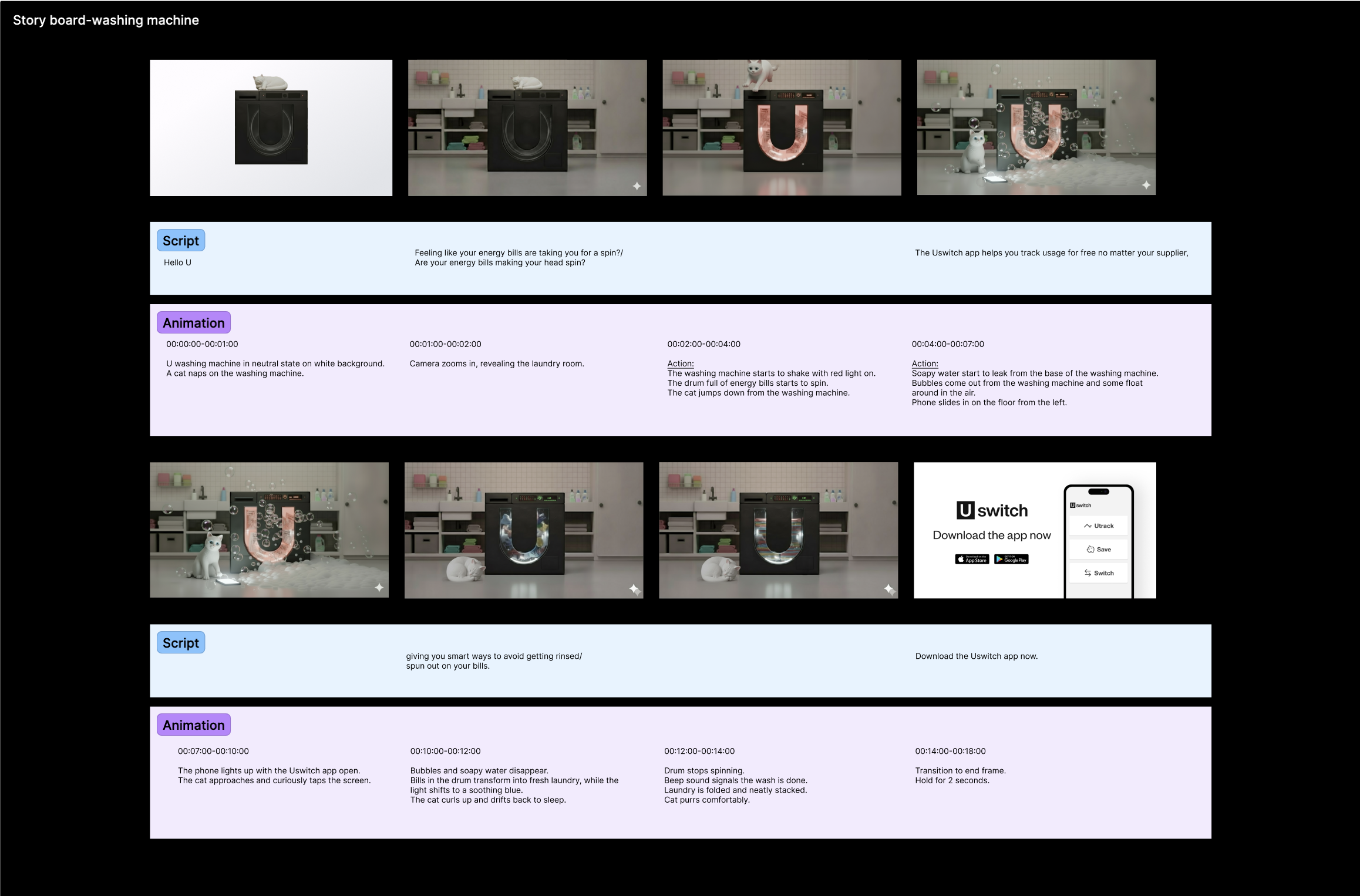 Storyboards for the 20S ATL-quality paid video before the brief change
Video experiment for the 20S ATL-quality paid video before the brief change
Learnings:
AI is most effective as an acceleration layer, not a replacement. AI-assisted workflows significantly improved speed, volume, and flexibility, but creative quality and performance depended on human judgement, brand control, and iterative testing.
Platform best practices should act as the creative north star. Creative strategy must align with how platforms optimise delivery. For example, YouTube favours multiple creative variations over a single high-production asset, reinforcing the importance of designing for testing, rotation, and iteration rather than perfection.
What I’d do nex: Template and operationalise the AI video production workflow to fully leverage AI efficiency, enabling high-volume, performance-led creative production at scale for future campaigns.
🖤️